Do you have to switch between reading glasses and distance glasses? Varifocal lenses are a convenient, cost-effective solution for those with multiple vision needs.
What are varifocal lenses and how do they work?
Multifocal lenses is an umbrella term that includes both bifocals and varifocals. Let’s take a closer look at varifocal lenses. Varifocal lenses (also known as progressive lenses) work by gradually changing in strength from the top to the bottom. Rather than having one specific strength across the whole lens (like single vision glasses), or two different areas of vision like bifocal lenses, varifocal lenses have three main zones of vision.
The top part of the lens is set for distance viewing, the middle part is set for intermediate viewing (like when using a computer), and the bottom part is set for close-up viewing. This means that you can easily do things such as check your text messages, use a cash machine and read a road sign all with one pair of glasses.
What's the difference between bifocal and varifocal lenses?
Bifocals have an invisible line on the lens whereas varifocals have a smooth, unobstructed surface. Another major difference is that bifocals can only help correct two distances, whereas varifocals can help correct all distances. Find out more about the differences here.
How long does it take to get used to varifocal lenses?
For some, it’s quick and easy to adapt to varifocals. For others, it can take a little bit of practice.
People who are new to varifocals may experience slight disorientation when moving quickly from one viewing zone to the next. If this happens, don’t worry, these sensations are normal and shouldn’t last long.
We advise patients to wear your glasses as often as possible to let your brain and eyes adjust.
Varifocals for presbyopia
Ever find yourself stretching your arm while trying to read a menu or text message? There is a chance that you have presbyopia, this is an age-related long-sightedness that most of us will experience as we head into our 40s.
A great way to deal with presbyopia is to wear varifocal frames or multifocal contact lenses.
Types of varifocal lenses
There are lots of different types of varifocal lenses. Depending on your lifestyle and prescription, your optician will help you find a set that’s right for you.
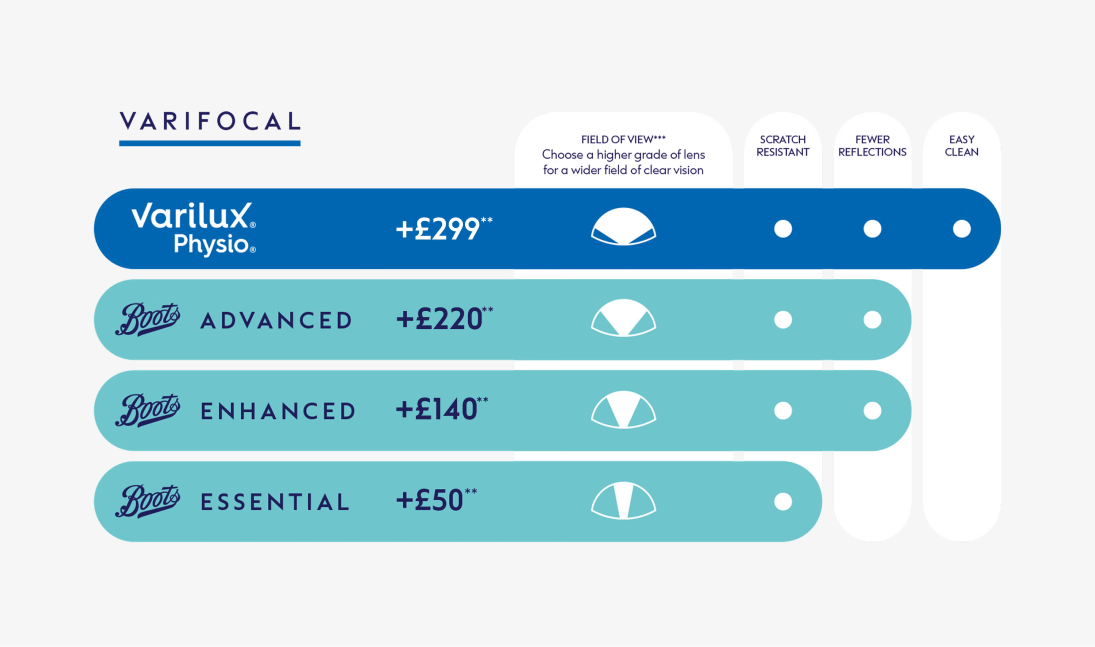
Our varifocal lenses are available in four options:
-
Essential: Our standard varifocal lenses are scratch resistant as standard
-
Enhanced: Our enhanced varifocal lenses are scratch resistant, plus they have fewer reflections. The field of vision is also wider than that of a standard lens. This lens is good for reading and light computer use
-
Advanced: Our advanced varifocal lenses include all of the benefits from our enhanced varifocal lenses, but with a wider field of vision. This lens is recommended if you are regularly changing distances and using the computer or reading for long periods
-
Varilux® Physio: These are our premium varifocal lenses. They come with all of the benefits from our advanced lenses, plus wider fields of vision and great contrast, whatever the situation and in any light conditions. These lenses are modified to the prescription of both of your eyes so that your eyes work better together, resulting in improved focus for smooth transitions between distance to near vision zones and vice versa.
Related articles