What is our Ultimate Eye Test?
Our Ultimate Eye Test gives a complete picture of your eye health . Our Ultimate Eye Test combines an optomap® eye scan, with ultra-wide imaging technology, an OCT scan (Optical Coherence Tomography), and your Essential Eye Test — which includes our Dry Eye Evaluation.*
Our Advanced Eye Test includes our Essential Eye Test and OCT scan, while the Essential Eye Test is a standard eye exam.
How much does an Ultimate Eye Test cost?
Our Ultimate Eye Test gives our most comprehensive view of your eye health and can help to detect health conditions that other scans alone might miss.** Because our Ultimate Eye Test involves additional scans, additional charges from £50 may apply.***
What is an optomap eye scan?
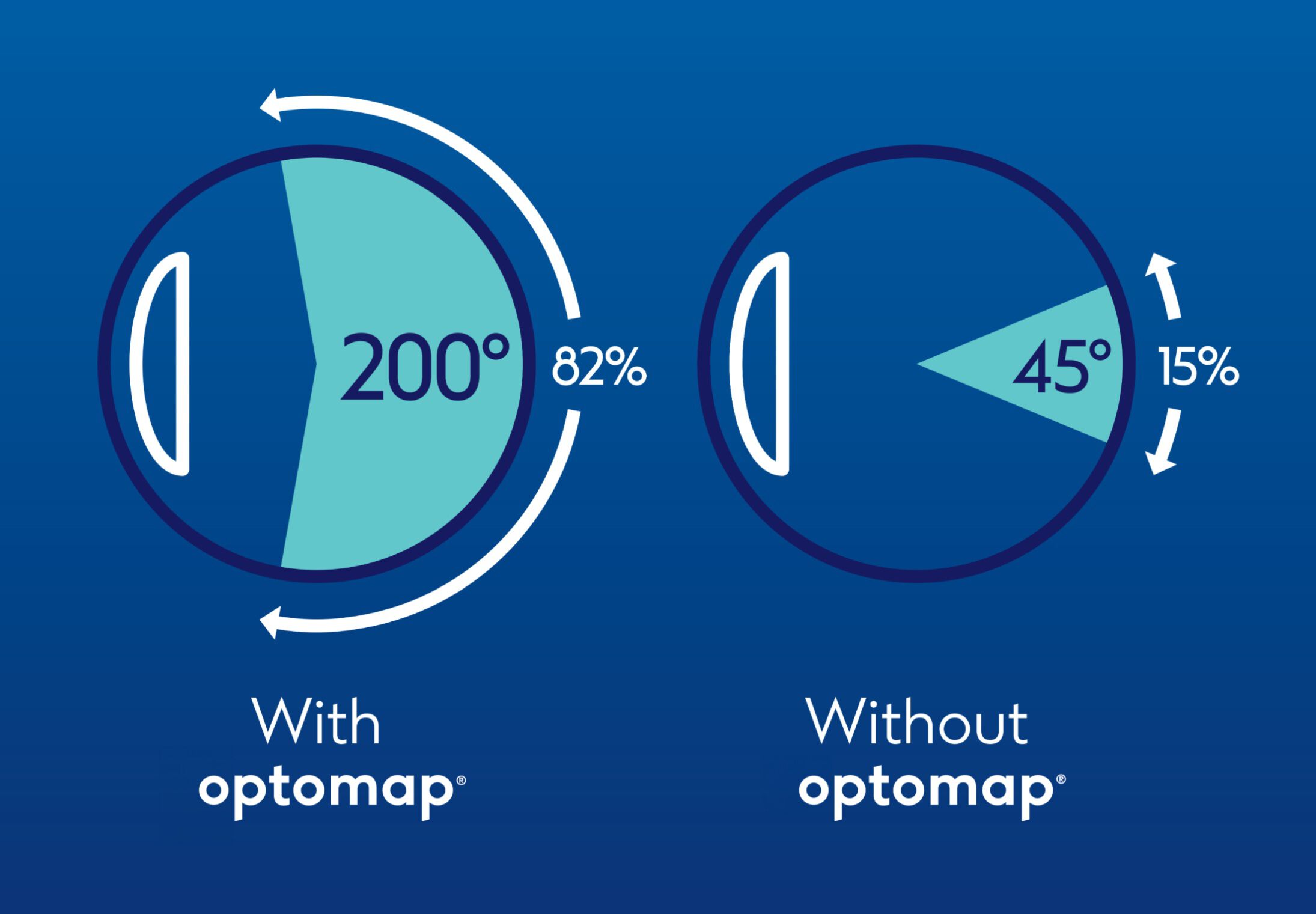
Our conventional scan allows the optometrist to view only 15% (a 45-degree area) of the retina at a time, whereas optomap captures up to 82% (a 200-degree area) in a single photograph, providing a more comprehensive view of your overall eye health.
optomap is quick, non-invasive, and painless, making the process both fast and comprehensive. You simply look into the device, one eye at a time, and a brief flash of light captures an image of your retina—similar to having a photograph taken.
optomap is available at selected stores. Book your eye test online today and ask in-store about upgrading to our Ultimate Eye Test.
Top benefits to having an optomap eye scan
-
As part of our Ultimate Eye Test, optomap can detect health conditions that other conventional eye scans alone might miss**
-
optomap captures up to 82% of the retina in one view, compared to 15% with a traditional eye scan
-
Helps to protect your sight and eye health
-
Quick and painless – nothing touches your eye at any time
-
Suitable for patients of all ages
-
Allows you to see a view of your retina in 3D animation
How optomap helps check for other health conditions
The eye is the only place in the body where blood vessels can be viewed directly, and these vessels can provide important insights into your overall health.
For example, diabetes can affect your eyes in multiple ways. Some people with diabetes may develop a complication called diabetic retinopathy, where consistently high blood glucose (sugar) levels damage the blood vessels in the eye. If left untreated, these changes can impact vision.
High blood pressure (hypertension) also affects many people and, over time, can damage blood vessels throughout the body, including those in the eyes. The resulting eye condition, known as hypertensive retinopathy, often shows no noticeable symptoms in the early stages.
Eye strokes can occur when a blood vessel within the retina becomes blocked. Depending on the location of the blockage, this can lead to partial or complete vision loss, which in some cases may be permanent.
Adding optomap and OCT through our Ultimate Eye Test allows the optometrist to capture more than 80% of your retina in a single image, helping with the detection and monitoring of these conditions.

optomap is beneficial for children, too
Eye diseases in children are thankfully rare and the vast majority of children have healthy eyes.
However, a small number of children may be born with, or go on to develop, eye disease which may not be obvious in the early stages.
Adding optomap to your child's eye examination will help the optometrist to see more of your child's retina in one image and monitor any changes over time.
The discovery of optomap
Did you know, this exam was created by a father whose child lost sight in one eye due to an undetected retinal detachment?
In 1992, Douglas Anderson OBE founded Optos after his then five-year-old son lost vision in one eye because a retinal issue wasn’t caught early enough. Despite regular eye exams, standard tests didn’t allow for a full view of the retina in one go. A wider field of view might have led to an earlier diagnosis.
Motivated by this, Anderson set out to develop a more comfortable and effective way to view the entire retina in one image, leading to the creation of optomap, giving people greater peace of mind and better chances of protecting their vision.

Healthy eyes top tips
Explore our top tips on keeping your eyes healthy through diet, habits and more

Frequently asked questions
How long has optomap been available?
optomap is CE Marked & has been available in the UK since 1999.
How many practices have this technology?
There are over 10,000 installed devices worldwide.
How soon will the optometrist see the results?
The optometrist will review the results with you shortly after.
Why is it important for the optometrist to look at the retina?
The sensitive tissue that makes up the retina is susceptible to a variety of diseases & it is essential to catch any problems early in their progression to avoid vision loss.
Can my child be tested?
Yes.
Can I wear my contact lenses during the optomap exam?
Yes.
Will it tell me if I have cataracts?
No, optomap looks at the retina which is at the back of your eye & cataracts develop in the lens which is situated closer to the front of your eye. Your optometrist will use different equipment to examine your lens.
I don’t have any complaints; I see well, why should I get this?
Some eye disorders do not cause pain or other symptoms. When detected early enough, many retinal problems can be treated to help avoid vision loss. Early detection is vital to preserving good eye health.
I have a family history of diabetes, should I have this done? Why?
It is particularly important for people who are at risk of diabetes to have an optomap since they are prone to problems with the retina that could lead to vision loss.
Can I drive after the exam?
Generally, yes. The optomap exam will not blur your vision or make you sensitive to light. However if you are dilated in combination with optomap, we recommend that you do not drive for 1 – 2 hours or as recommended by your optometrist.
Does this hurt?
No, the optomap should be very comfortable for you.
Can taking an optomap cause any damage?
No, you will just notice a flash like a photograph.
How often is it recommended to have an optomap done?
We recommend that optomap should be part of every eye exam to help monitor any changes to eye health. Note: Patients with diabetes or known pathology & who are being managed by their optometrists should be careful to follow the schedule recommended by their optometrist.
Is it sanitary?
Yes. The eyepieces are cleaned with alcohol wipes.
Will this change my prescription?
optomap will not change the current prescription.
Can I have a copy of my test?
A PDF report of your optomap image can be emailed to you on request. Please speak to a member of the store team
I am pregnant; can I have the test done?
Yes.
I don't pay for my eyesight test – do I still have to pay for an optomap?
Yes, unfortunately, the NHS does not cover advanced diagnostic screening. Because our Ultimate Eye Test involves separate scans to our Essential eye test, additional charges from £50 may apply. Price may vary across regional stores.
Terms and conditions
*Our Dry Eye Evaluation is included as part of every adult sight test only.
**In comparison to single image capture
***Additional charges from £50 may apply. Price may vary across regional stores